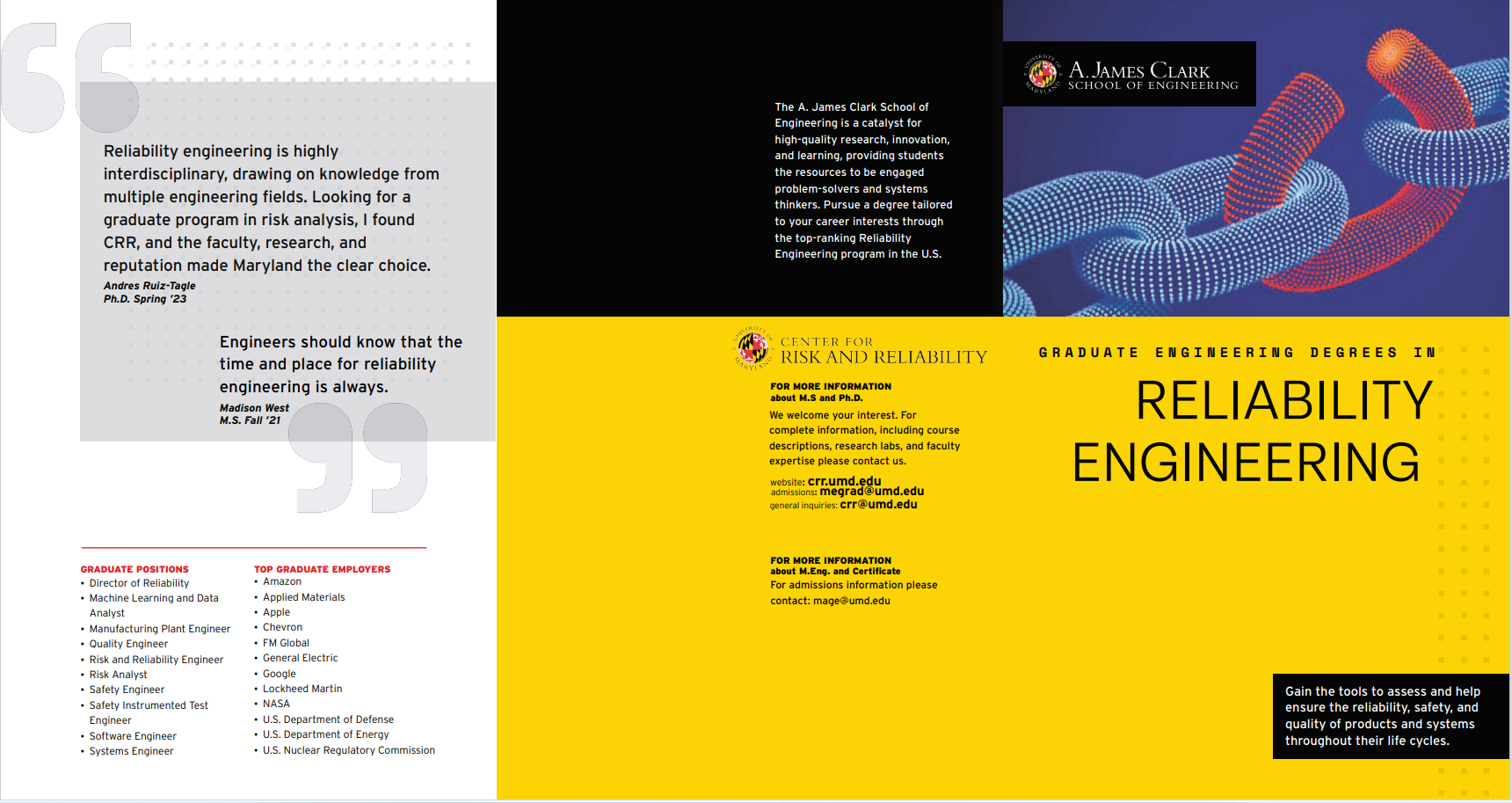
The Doctor of Philosophy degree is awarded in recognition of a high level of scholarship, the ability to carry out independent research, and the publication of such research in archival journals. A high level of academic achievement is expected in the course work completed by the student. Every Ph.D. student will conduct scholarly research in the area of risk and reliability engineering and will write a dissertation that describes that research.
The Master of Science Program in Reliability Engineering is awarded for successful completion of a unified, coherent program of coursework and research that is approved by the student's advisory and graduate director and meets Graduate School requirements. A high level of academic achievement is expected in the course work completed by the student. M.S. students are expected to complete a thesis that describes their research in the area of risk and reliability engineering.
The Professional Master of Engineering (M. Eng.) program is a practice-oriented, full or part-time graduate program specifically designed to assist engineers in the development of their professional careers and provide the technical expertise needed in business, government, and industrial environments. The M. Eng. degree may be completed both in-person or online.
Requirements
Admission
The Graduate Certificate in Engineering (GCEN) program provides a certificate designed for part-time students who want to continue their education while working full-time. The program is application-oriented, and most students work full-time for employers that support their continuing education. The program does not provide financial support for graduate students.
Students interested in ultimately pursuing a Ph.D. should enroll in the M.S. in Reliability Engineering program to establish a background appropriate for a research degree. The program is open to qualified applicants holding a regionally accredited baccalaureate degree in engineering or a related field. In addition to submitting a Graduate School admission application with fee, a copy of the applicant's college transcripts is required for evaluation. Applicants with an undergraduate GPA of less than 3.0 may be admitted on a provisional basis if they have demonstrated a satisfactory experience in another graduate program and/or their work experience has been salutary. In that case, two recommendation letters are requires as well. Applicants with foreign credentials must submit academic records in the original language with literal English translations. Please allow at least three months for evaluation of these credentials.
The student completes 12 credit hours of approved coursework with an average grade of B. The coursework, which can include up to 3 credits at the 400-level, must be approved by the GCEN faculty advisor within the selected department. The 12 credits used for the Graduate Certificate in Engineering can be applied toward the 30 credits required for the Master of Engineering, should the student be admitted to that program on completion of the Certificate.
Requirements
Admissions
Short courses on the basics of reliability engineering are offered by outside organizations such as the Reliability Engineering Academy.
CRR offers short courses on advanced topics in risk and reliability engineering. The content and delivery of short courses can be tailored to the needs of a specific community or course sponsor.
Please contact us at crr@umd.edu for more information.
The following are some short courses that CRR faculty have offered:
Selected Short Courses
- Engineering Risk Management, 2015
- Decision and Risk Analysis, 2014
- Advanced Methods for Reliability Data Collection and Analysis, Petrobras, Rio de Janeiro, Brazil, Sept. 2012
- Probabilistic Risk Assessment and Management, 2010
- Advanced Probabilistics Risk Assessment Methods, Korea Atomic Energy Research Institute and Korean Aerospace University, Sept. 2009
- Probabilistic Risk Assessment Training, NASA, Dec. 2000, April 2001, July 2002, July 2003, Oct. 2005, Oct. 2006, June 2008, Oct. 2009
- Dynamic PRA Methods, China National Defense University, China, Oct. 2008
- Advanced Methods for Reliability, US Air Force, July 2007; US Navy, August 2007
- Dynamic PRA Methods, NASA Ames Research Center, July 2002
- Stochastic Processes for Risk Applications, NASA Johnson Space Center, June 2002
- Elicitation and Use of Expert Opinions in Risk Analysis, NASA Johnson Space Center, May 2002
- Data Analysis for Risk Applications, NASA Johnson Space Center, April 2002
- Methods of Elicitation and Use of Expert Opinion, USDA, Feb. 2002
- Bayesian Reliability, Motorola, March 2000
- Advanced Methods for Systems Reliability, Motorola, Jan. and June 1999
- Advanced Reliability Methods, US Navy, Oct. 1997
- Methods for Safety Analysis of Nuclear Facilities, International Atomic Energy Agency, Madrid, Spain, April 1993
- Methods for the Analysis of Common Cause Failures, National Technological University, Aug. 1992
- Dynamic PRA and Human Reliability, Institute for Nuclear Energy Research, Taiwan, August 1991
- Quality PSA: What a PSA Review Should Look For, International Atomic Energy Agency, Vienna, Austria, Aug. 1990
- PRA Techniques, Tsinghua University, Beijing, China, Dec. 1989
- Data Analysis and Common Cause Failure Modeling, Massachusetts Institute of Technology, July 1989
Megan Wells
Graduate Program Manager
2170 Glenn L. Martin Hall
Phone: 301-405-4216
Email: mpetry@umd.edu